Among all provisions in a Builders Risk (Course of Construction) policy, no clause generates more claim disputes, partial denials, or litigation than the Faulty Workmanship, Material, or Design (FWMD) exclusion.
This is not because the exclusion is ambiguous in isolation. Builders Risk policies are typically written on an all-risk basis, which creates an expectation of broad coverage, until the FWMD exclusion carves out the inherent risk of human error. The legal friction arises at the boundary where excluded faulty work gives rise to subsequent physical damage caused by an otherwise covered peril.
The distinction between excluded faulty work and covered resulting damage is the single most important concept in construction property insurance. It is also the point at which many insureds unintentionally destroy their own claims through poor documentation, mischaracterization of loss causation, or failure to segregate costs.
This article addresses that boundary with a legalistic, procedural, and claim-oriented lens, providing the framework required to survive scrutiny by insurers, forensic engineers, and coverage counsel.
1. Defining the Core Exclusion: Faulty Workmanship, Material, or Design (FWMD)
What Constitutes Faulty Workmanship, Material, or Design
In Builders Risk policies, FWMD generally includes:
- Faulty workmanship
Improper installation methods, incorrect fastening, poor welding, inadequate curing, or deviation from approved construction procedures. - Faulty materials
Use of non-conforming, defective, or unsuitable materials, including materials that fail prematurely due to inherent defects. - Faulty design
Errors or omissions in architectural or engineering plans, specifications, or calculations (e.g., load miscalculations, improper detailing).
Importantly, FWMD is not limited to gross negligence. Minor deviations, such as using an incorrect fastener, torque value, or sealant, can qualify as faulty workmanship if they render the work defective.
Why Insurers Exclude FWMD
FWMD is excluded because it represents controllable, preventable, and predictable risk. From an underwriting perspective:
- It is within the contractor’s control
- It can be mitigated through quality control
- It is not fortuitous or accidental
Property insurance is designed to cover fortuitous loss, not the cost of correcting professional mistakes. That risk is intended to be transferred through:
- Contractual indemnification
- Professional liability
- General liability (in limited resulting-damage contexts)
The Financial Exposure of the Exclusion
The direct cost of correcting faulty work is typically obvious. The indirect exposure is far greater:
- Tear-out costs to access defective work
- Schedule delays triggering liquidated damages
- Loss of use or revenue
- Secondary damage to adjacent trades
The exclusion applies only to the defective work itself, but if the claim is not handled correctly, insurers may attempt to extend the exclusion far beyond its legal intent.
2. The Critical Distinction: Resulting Damage – Where Coverage Begins
The Resulting Damage Exception (RDE)
Most Builders Risk policies contain an implicit or explicit Resulting Damage Exception (RDE).
Core rule:
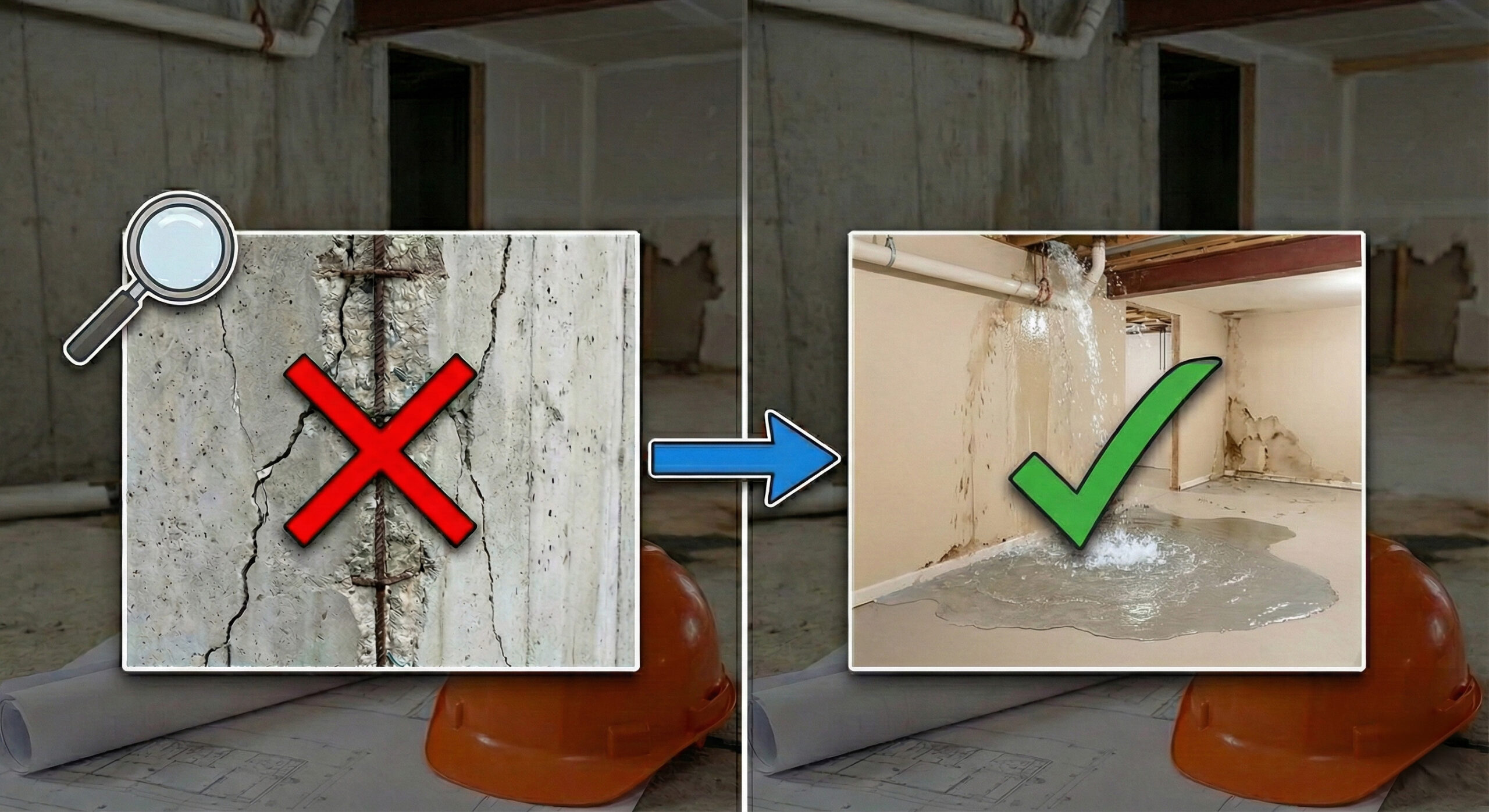
The cost to repair or replace faulty workmanship, materials, or design is excluded, but physical damage caused by a subsequent covered peril is generally covered.
This principle is widely recognized in coverage jurisprudence and underwriting practice, though it is highly dependent on policy wording.
How Resulting Damage Is Triggered
For resulting damage to be covered, three elements must typically be established:
- Faulty work existed (excluded condition)
- A separate, subsequent peril occurred (e.g., water discharge, collapse, fire)
- That peril caused additional physical damage beyond the faulty work itself
The covered peril does not need to be catastrophic. What matters is that it is distinct from the faulty act.
Procedural Reality: Coverage Is Won or Lost in Cost Segregation
Resulting damage coverage does not fail because it does not exist. It fails because insureds fail to segregate costs.
At claim time, the insurer will demand a clear separation between:
- Excluded cost: correcting the faulty work
- Covered cost: repairing damage caused by the resulting peril
If the insured cannot demonstrate this distinction with documentation, the insurer may reasonably apply the exclusion broadly.
3. Real-World Application: Covered vs. Excluded Loss Scenarios
Case Study 1: Structural Welding Defect Leading to Collapse
Facts
A steel subcontractor performs faulty welds on structural connections. Weeks later, a windstorm causes partial structural collapse.
Coverage Analysis
- Faulty welds → excluded (FWMD)
- Windstorm → covered peril
- Collapse of structural members caused by wind loading → resulting damage
Adjustment Outcome
- Cost to re-weld defective joints: excluded
- Cost to rebuild collapsed structural sections, debris removal, and re-erection: covered
Key lesson
The collapse must be attributed to wind force, not merely the existence of faulty welds.
Case Study 2: Defective Roof Flashing and Interior Water Damage
Facts
Improperly installed flashing allows rainwater intrusion over time. Moisture damages interior drywall, insulation, and flooring.
Coverage Analysis
- Defective flashing → excluded
- Rainwater intrusion → covered peril
- Interior water damage → resulting damage
Adjustment Outcome
- Replacement of flashing: excluded
- Drywall removal, drying, mold remediation, and interior finishes: covered
Common failure point
If moisture intrusion is characterized as “gradual seepage” without identifying a discrete rain event, insurers may deny resulting damage.
4. Proactive Mitigation: Loss Control Protocols for FWMD Exposure
The most effective way to preserve resulting damage coverage is to prevent ambiguity.
A. Subcontractor Risk Backstopping
- Require Professional Liability (E&O) from design-influencing trades
- Set minimum limits aligned with project value
- Contractually require survival of coverage beyond completion
B. Inspection and Sign-Off Protocols
Implement documented inspection checkpoints before concealment:
- plumbing pressure tests
- electrical inspections
- structural connection sign-offs
- waterproofing inspections
Each sign-off creates a temporal record that separates faulty work from subsequent events.
C. Third-Party Quality Control
Independent commissioning agents or forensic inspectors during rough-in phases provide:
- contemporaneous evidence
- neutral documentation
- credibility in claim disputes
This is especially valuable for high-value or lender-controlled projects.
5. Policy Nuance: Endorsements That Modify FWMD Risk
Broadening Endorsements
Some policies include endorsements that:
- clarify or expand the definition of resulting damage
- provide limited sub-limits for tear-out costs
- soften the exclusion for ensuing loss
These endorsements are rare and must be reviewed carefully.
Narrowing Endorsements (Red Flags)
Be cautious of policy language that includes:
- anti-concurrent causation applied to FWMD
- “regardless of any other cause” wording
- absolute defect exclusions eliminating ensuing loss
These provisions can eliminate the resulting damage exception entirely.
6. Establishing an Audit Trail to Protect the Claim
Claims involving FWMD are won on documentation, not argument.
Critical documentation includes:
- daily logs
- weather data
- inspection reports
- photographs before and after loss
- forensic causation reports
Early engagement of coverage counsel or a specialized claims consultant is often decisive.
Conclusion
Faulty workmanship exclusions are not claim killers by default. Poor claim handling is.
Projects that succeed in Builders Risk claims do three things consistently:
- They prove a covered peril occurred
- They segregate excluded and covered costs precisely
- They maintain an auditable trail from construction through loss
For senior executives and risk professionals, the question is not whether FWMD exists. It is whether your organization is prepared to prove resulting damage under scrutiny.
Final Advisory
Adopt a risk management plan that treats documentation as insurance. When a loss occurs, stop construction, preserve evidence, and involve specialists immediately. In Builders Risk claims, the outcome is often determined in the first 72 hours. Need Builders Risk Insurance? Get your free, instant quote today.